Optimize the Context Window
Use this when you need to control how the runtime manages conversation history to stay within model token limits.
Prerequisites
Section titled “Prerequisites”awakencrate added toCargo.toml- An agent configured with
AgentSpec
ContextWindowPolicy
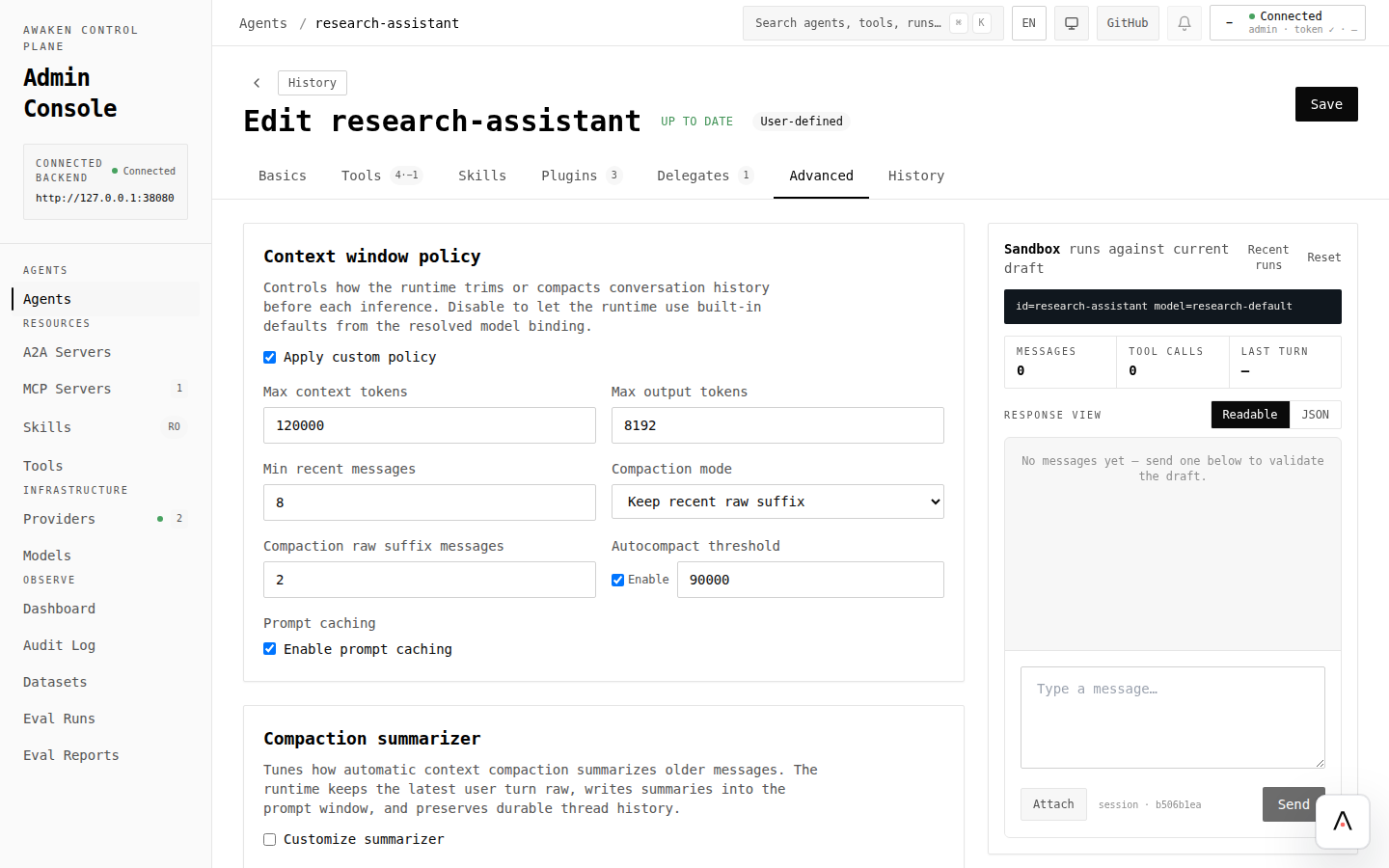
Section titled “ContextWindowPolicy”Every agent has a ContextWindowPolicy that controls how conversation history is managed. Set it on your AgentSpec:
use awaken::ContextWindowPolicy;
let policy = ContextWindowPolicy { max_context_tokens: 200_000, max_output_tokens: 16_384, min_recent_messages: 10, enable_prompt_cache: true, autocompact_threshold: Some(100_000), compaction_mode: ContextCompactionMode::KeepRecentRawSuffix, compaction_raw_suffix_messages: 2,};Fields
Section titled “Fields”| Field | Type | Default | Description |
|---|---|---|---|
max_context_tokens | usize | 200_000 | Model’s total context window size in tokens |
max_output_tokens | usize | 16_384 | Tokens reserved for model output |
min_recent_messages | usize | 10 | Minimum number of recent messages to always preserve, even if over budget |
enable_prompt_cache | bool | true | Whether to enable prompt caching |
autocompact_threshold | Option<usize> | None | Token count that triggers auto-compaction. None disables auto-compaction |
compaction_mode | ContextCompactionMode | KeepRecentRawSuffix | Strategy used when auto-compaction fires |
compaction_raw_suffix_messages | usize | 2 | Number of recent raw messages to preserve in suffix compaction mode |
Truncation
Section titled “Truncation”When the conversation exceeds the available token budget, the runtime automatically drops the oldest messages to fit. The budget is calculated as:
available = max_context_tokens - max_output_tokens - tool_schema_tokensWhat truncation preserves
Section titled “What truncation preserves”- System messages are never truncated. All system messages at the start of the history survive regardless of budget.
- Recent messages — at least
min_recent_messageshistory messages are kept, even if they exceed the budget. - Tool call/result pairs — the split point is adjusted so that an assistant message with tool calls is never separated from its corresponding tool result messages.
- Dangling tool calls — after truncation, any orphaned tool calls (whose results were dropped) are patched to prevent invalid message sequences.
Artifact compaction
Section titled “Artifact compaction”Before truncation runs, oversized tool results are compacted automatically. By default, a tool result whose text is at or above 2048 estimated tokens is truncated to a preview of at most 1600 characters or 24 lines, whichever is shorter. The preview includes a compaction indicator showing the original size. Per-agent tuning lives under sections.context_transform.artifact_compaction with threshold_tokens, preview_max_chars, and preview_max_lines; all three values must be at least 1.
Non-tool messages (system, user, assistant) are never subject to artifact compaction.
Compaction
Section titled “Compaction”Compaction summarizes older conversation history into a condensed summary message, reducing token usage while preserving context. Unlike truncation (which drops messages), compaction replaces them with a summary.
Enabling auto-compaction
Section titled “Enabling auto-compaction”Set autocompact_threshold to trigger compaction when total message tokens exceed that value:
let policy = ContextWindowPolicy { autocompact_threshold: Some(100_000), compaction_mode: ContextCompactionMode::KeepRecentRawSuffix, compaction_raw_suffix_messages: 4, ..Default::default()};ContextCompactionMode
Section titled “ContextCompactionMode”Two strategies are available:
KeepRecentRawSuffix(default) — keeps the most recentcompaction_raw_suffix_messagesmessages as raw history. Everything before the compaction boundary is summarized.CompactToSafeFrontier— compacts all messages up to the safe frontier (the latest point where all tool call/result pairs are complete).
The compaction boundary is chosen so that no tool call is separated from its result. The boundary finder walks the message history and only places boundaries where all open tool calls have been resolved.
CompactionConfig
Section titled “CompactionConfig”The compaction subsystem is configured through CompactionConfig, stored in the agent spec’s sections["compaction"] and read via CompactionConfigKey:
use awaken::CompactionConfig;
let config = CompactionConfig { execution_mode: CompactionExecutionMode::Background, summarizer_system_prompt: "You are a conversation summarizer. \ Preserve all key facts, decisions, tool results, and action items. \ Be concise but complete.".into(), summarizer_user_prompt: "Update the cumulative conversation summary.\n\n\ <existing-summary>\n{previous_summary}\n</existing-summary>\n\n\ <new-conversation>\n{messages}\n</new-conversation>".into(), summary_max_tokens: Some(1024), summary_model: Some("claude-3-haiku".into()), min_savings_ratio: 0.3, raw_retention: CompactionRawRetention::PreserveDurable,};| Field | Type | Default | Description |
|---|---|---|---|
mode | CompactionExecutionMode | background | background runs summaries asynchronously; off disables automatic compaction even when the threshold is set |
summarizer_system_prompt | String | Conversation summarizer prompt | System prompt for the summarizer LLM call |
summarizer_user_prompt | String | Cumulative summary prompt | User prompt template; {messages} is replaced with the conversation transcript and {previous_summary} with the prior summary when present |
summary_max_tokens | Option<u32> | None | Maximum tokens for the summary response |
summary_model | Option<String> | None | Upstream model override for summarization on the same resolved provider/executor. If this value matches a registry model id, it must belong to the agent model’s provider and is normalized to that model’s upstream name |
min_savings_ratio | f64 | 0.3 | Minimum token savings ratio (0.0-1.0) to accept a compaction |
raw_retention | CompactionRawRetention | preserve_durable | Compaction rewrites the runtime prompt window but preserves original user messages in durable thread/run history |
The compaction pass only runs when the expected savings ratio exceeds min_savings_ratio. A minimum gain of 1024 tokens (MIN_COMPACTION_GAIN_TOKENS) is also required to justify the summarization LLM call.
DefaultSummarizer
Section titled “DefaultSummarizer”The built-in DefaultSummarizer reads prompts from CompactionConfig and supports cumulative summarization. The same summarizer_user_prompt template is used for initial and incremental compaction; include {previous_summary} when you want the prompt to carry the prior cumulative summary forward.
The transcript renderer filters out Visibility::Internal messages before sending to the summarizer, since system-injected context is re-injected each turn and should not be included in summaries.
Background execution
Section titled “Background execution”Compaction does not block the inference phase. When the conditions are
met, maybe_spawn_compaction plans the boundary, writes a
CompactionInFlight marker into CompactionStateKey, and offloads the
summarization LLM call to a background task through the agent’s
BackgroundTaskManager. The completion event flows back through the owner
inbox; try_consume_compaction_event picks it up and apply_summary swaps
the summary into the message log if the boundary is still present.
Two consequences worth knowing:
- Compaction is single-flight per agent. While
CompactionState::is_compactingis true, subsequent inference rounds skip planning a new compaction and run with the un-compacted history. Once the swap completes, the next round continues with the summarized prefix. - Config-driven local runs automatically attach the built-in summarizer and a
per-run
BackgroundTaskManagerwhenautocompact_thresholdis set andmodeisbackground. Custom runtimes that constructResolvedAgentdirectly must provide both; without either,maybe_spawn_compactionis a no-op and the runtime falls back to truncation. - The latest user turn is always kept raw in the prompt window. Older user messages can be summarized, but durable thread/run history is preserved.
KeepRecentRawSuffixkeepscompaction_raw_suffix_messagesat the tail.CompactToSafeFrontierrolls the window forward to the latest safe frontier while honoringmin_recent_messages. Both modes avoid splitting tool call/result pairs.
Summary storage
Section titled “Summary storage”Compaction summaries are stored as <conversation-summary> tagged internal system messages. On load, trim_to_compaction_boundary drops all messages before the latest summary message, so already-summarized history is never re-loaded into the context window.
Compaction boundaries are tracked durably via CompactionState, recording the summary text, pre/post token counts, and timestamp for each compaction event.
Truncation recovery
Section titled “Truncation recovery”When the LLM stops due to MaxTokens after producing partial text or incomplete tool calls (argument JSON was truncated mid-generation), the runtime can automatically retry by injecting a continuation prompt asking the model to break its work into smaller pieces and continue. The retry count is tracked by TruncationState and bounded by a configurable maximum.
Key Files
Section titled “Key Files”crates/awaken-runtime-contract/src/contract/inference.rs—ContextWindowPolicy,ContextCompactionModecrates/awaken-runtime/src/context/transform/mod.rs—ContextTransform(truncation)crates/awaken-runtime/src/context/transform/compaction.rs— artifact compactioncrates/awaken-runtime/src/context/compaction.rs— boundary finding, load-time trimmingcrates/awaken-runtime/src/context/summarizer.rs—ContextSummarizer,DefaultSummarizercrates/awaken-runtime/src/context/plugin.rs—CompactionPlugin,CompactionConfig,CompactionStatecrates/awaken-runtime/src/context/truncation.rs—TruncationState, continuation prompts